Monday, 29 September 2014

VOYNICH CONSEQUENCES I

Take 8 texts and 8 people.
Each person selects five lines and copies them out.
Re-distribute the copied lines amongst the contributors.
Attempt to construct a narrative by each person placing a line in turn.
Illustrate the story.

(this may take some time)


I have, however, a hundred objections to make. Uncle Jerry had a smell too. His looks repel him; their brown backs and their dusty tops seem to jeer at his loneliness. Hear him, with voice thick and husky, a cracked laugh, talking rubbish and ribaldry, and in the midst of balderdash gleaming now and then a gorgeous sentence that drivels away again into a cadence almost idiotic. In this manner hours passed by without further interruption. 

"Upon them were found the letters from Hannibal to Philip..."

Then, for the first time, Hawkeye was seen to stir: how could anyone compel her to submit to someone who had so insulted her? Two powerful warriors cast themselves on Heyward, while another was occupied with securing the less than active singing-meister.  Upon them were found the letters from Hannibal to Philip, and a copy of the treaty.


"Our feelings ought to be respected!"


The Senate, after making such an answer as pleased all the ambassadors, ordered M. Valerius Levinis, the proprietor, to advance towards Macedonia with a fleet, in order to examine matters nearer at hand, and be in a condition to give immediate aid to the allies.  


"Well, you wouldn't credit how ladylike she looks. Were you fond of Venetia? You could scarcely bear to see her walking. "


"Yes, and it's over now."

"The interested eyes of the lieutenant sort her frequently..." 

The interested eyes of the lieutenant sought her frequently, and he felt a secret pleasure at the thought that probably he would be allowed to enjoy her society for a whole week, maybe two, for the marching orders ran "until further orders".  A gentle murmour expressed the sentiments of all that were present. Daddy was getting angry. 


"I know they would, I heard two religious ladies talking about me."

"The Welsh?"

"I hope your beast won't bear malice, Tom, for this would be an awkward place for him to try his capers. To say that is only [****] is on many accounts a thing to be deeply deplored."

"If I may venture upon a suggestion," said old Mrs Von Bock blandly, "it would be to fetch them both at the same time with the carriage."


"Then Miss Eden raised her to her heart and told her her sweet secret."
Then Miss Eden raised her to her heart, and told her her sweet secret. Venetia was astounded and hurt.

"Noa," said her father, "what does she want wi' readin' an' larnin'? It ought not so to be!"


"Who will say to the wife of Merawgwa that her fishes have his scalp, and that his nation have not taken revenge! The Lord has done great things for us these last hundred years. If any man thinks that our cause is in no great danger, I can only marvel at his blindness. One thing is very clear, and that division is a great cause of our weakness."


"Venetia, but fore her shadowy legs, was a plump child."
Venetia, but for her shadowy legs, was a plump child. She was a hedonist, but she was intelligent enough to be sceptical of pleasure. She did not seem to guess the vicar was there...

"Anciently, my tributaries!"

""Bringing before his mind's eye the symbol of his faith..."
Bringing before his mind's eye the symbol of his faith, he strove, by contemplation of the sublime love and pain, to melt his heart into tenderness for the suffering wretch he was going to see, and to bring more vividly before him his terrible condition.

By this time Duncan was thoroughly awake, and he immediately lifted the shawl from the sleeping females. Didn't I tell you he was going off his head, and that I wanted to know what is best to do for him? Romans. Romans to bring over other kings to their fide by the attractive charms of advantage.

You were all horribly afraid, I know, at the beginning, that it was going to be a love-story; and one is really so tired of them. Venetia's childhood is not that interesting.


Wednesday, 10 September 2014

EPHEMEROPOLIS [CITY OF IMPERMANENCE]


You teased her about her accent, strange RP-Cumbrian hybrid, she admitted she was posh. It was a dance, of course: contrived and spontaneous, utterly affected yet entirely uninhibited. So you allowed yourself a smirk, pleased at producing something passably insightful at this late hour, in these unfamiliar arms, beneath an alien sky.

The details of the dance are never the same but the theme is constant. As in the city, you were empowered by your own insignificance. You felt small and unimportant and it made you feel sublime. A pixel in the bigger picture. Lurking, always, was the terror- part of you clung to itself. Part of you was unwilling to be swallowed by the glorious whole. This quiet yet persistent voice was the ghost of you, trapped in meat and bones, trying to find itself. It searched for its own reflection in the eyes of others, and in reaching to embrace its own echo, became entangled in flesh. Only then did it realise its purpose. Only then was it truly you and you truly yourself... or some idea of yourself with which you were comfortable.

You could tell she liked horses, it went with the accent. You had a piece prepared, something about a song and something being lost in translation... about the primitive instinct of all children to cover their cavern walls with animals. It wasn't necessary, you'd both got what you wanted. Maybe you wanted something more. Maybe you were asking too much.

You were asking too much. Distantly, a plaintiff cry of "Terrible presence! Eat me or perish!"

Her arms were wrapped around your neck, you stared up at a canopy of man-made fibres. Suddenly everything became very real: outside, dawn broken, no stars but one shining down on the city of mud and ketamine. You didn't want to leave, did you? You wanted to remain entwined within her, long and lithe, a heaven of flesh and black curls, but the world was seeping in, slow and insidious, mud and ketamine. Then the alarm, something out of sync. Though it wasn't meant to be so the exchange of numbers felt cursory, and with disappointment you entered the new world.

Stretching into an improbable infinity an ocean of poorly erected tents buckled and writhed beneath hammer-and-nails rain. Man-made fibres in gaudy colours, flapping in the south westerly, monuments to haste, their crooked poles creaking, filling the silence of muddied youth face-planted in the sodden ground. One foot falls in front of the other, clumsily edging around the quagmire, a dance too, of sorts.

Men in luminous jackets guide the way. Don't climb on trees. Don't enter where it says exit. The Lord of Misrule ordains that the misfits now set the boundaries. Toothless meth grin and a walkie-talkie. The marginalised becoming the respected; the respected the marginalised. Inversion, carnivalesque. Bakhtin.

Bakhtin? Bullshit.

Just one of several visions of the same thing, invisible city inside every city, endlessly repeated kaleidoscope li[v]es... you are lonely. You think predetermined, pre-packaged thoughts. You are xerox, simulacra, you are nothing.

You are nothing without someone else.

I followed your breadcrumbs into the woods.

"We're in the woods?"

"You dropped these."

"Where have we just been?"

"Where are we now?"

"That won't be important until later."

When everything became realistic again, you called her number. It was not recognised, predictably. 

Wednesday, 13 August 2014

20 000 VIEWS

In celebration of reaching 20,000 views, I think it's only fitting to post a video of some water getting sucked down an unseen hole.


Sunday, 27 April 2014

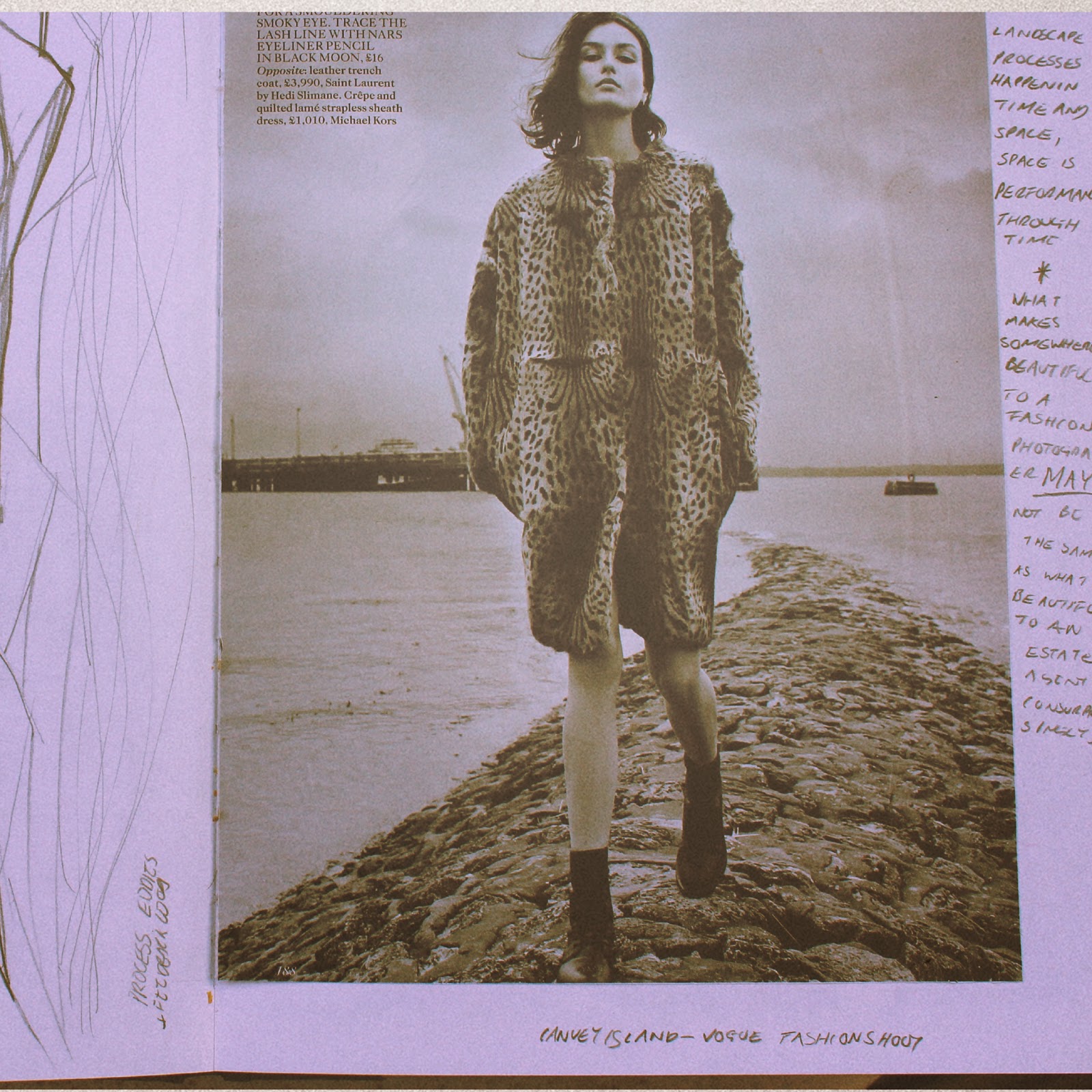
VOGUE COMES TO CANVEY


In November 2013 UK vogue decided to use Canvey Island as the location for a fashion shoot. The spread was titled Somewhere Girl- Be Carried Away by the Tides of the Season and featured a solitary model expertly shot in a variety of implausible locales around Canvey’s sea front.

The choice of location was perhaps not especially remarkable. The juxtaposition of the glamorous world of fashion against the mundanity of a fairly typical British seaside resort in fairly typical British decline serves the art director’s goal of emphasising the aspirational aspect of buying and wearing expensive clothing. It could be seen as yet another example of the fetishisation of entropy, with its antecedents in the ready-made-ruins of the picturesque garden through to the hyper documentation of central Detroit’s decline via Bernard Tschumi’s 1970s Advertisements for Architecture (“the most architectural thing about this building is the state of decay in which it is [sic]”)...though were that the intention the occidental jetty may have been a better choice of shooting location.


However, what this vapid and ephemeral fashion shoot emphasises is the way in which landscape is defined by activity. A thorough survey, a psychogeographic exploration of the temporal and historical currents running thorough the site, even GIS- do these data gathering exercises do anything other than build upon existing preconceptions in the designer’s mind? Preconceptions that can be swept away by the actions of an individual or group with their own agenda.

A landscape can be a habitat or a golf course or a playground... It can also be the location for a fashion shoot, a crime scene or a battlefield... or all of these things.  What defines space is what happens there, or in the words of Albert Camus: “Sense of space is not something that you feel, it’s something that you do.”
A landscape architect will design space with some concept of programme, perhaps defined by the brief and augmented by their own imagination. But once it is constructed, design intent is revealed to be illusory: on top of the layers imported from AutoCAD and Photoshop the user superimposes their own ideas of how the designed space is to be occupied and experienced.


So too in this post: the landscape architect’s notebook, full of oblique narrative and esoteric references, is laid bare... Only to be trampled on by someone else’s vision of what this island means.


Monday, 16 September 2013

THE VOYAGE OF победа

Lieutenant Tatiana Preobrajenskaya chewed her lower lip as she reduced the throttle on the победа as its final destination drew closer. The 32,000 tonne  Russian freighter under her control was due to dock at London Gateway in less than ten minutes, but the young woman had other designs for the победа, and her window of opportunity was closing.

Ahead of the vessel and just off the starboard bow loomed the island of Canvey. Though in plain view, Tatiana thought it pertinent to bring up a schematic of the  island’s southern coast on her display monitor. She managed a thin smile as she considered the schizophrenic imagination behind the master plan for this peculiar corner of the globe. Many years ago funding from the European Union had resulted in the creation of a daring development on the 186 hectare site. The objective had been to create 4,000 new homes along a strip of land lying largely below sea level, principally to accommodate the many workers at Tatiana's ostensible destination, Britain’s largest deepwater container port. The plan was to provide the services and infrastructure essential for the social sustainability of this new community; to furnish the thousands of new residents with spaces to exercise, to play and to consume as well as putting a roof over their heads. Grand in scope and ambition, it had been considered vital for the regeneration of the sluggish regional economy.

That desperation to resolve the economic malaise and return everything to the pre-crash status quo had led to some surprising design decisions slipping past the planning review panel. Tatiana chuckled slightly as the first zone of development came into view. Though the most conventional element within the overall plan it nevertheless demonstrated the ambition of what was to come. Addressing the constraint of the monolithic flood sea-defences by building atop the 1950s sea wall, establishing a new concourse and promenade above the original sea front which now served as a subsurface conduit for vehicular traffic. The exception to this approach had been around Ove Arup’s pavilion, which though dwarfed by the emerging residential structures was re-connected to land and sea by situating it within a sunken bowl, simultaneously referencing the prevailing marine modernism that once characterised the seafront.

The active waterfront engaged in a new dialogue with the tide, a dialogue that was joined not only by residents but also (and for the first time in many years) tourists, too.   This dialogue was extended by the extrusion of existing jetties into the water, creating a framework for new landscapes and vertical built form- a theme that would be expanded on deeper within the scheme.

Tatiana observed the density of the urban grain subside somewhat as it encroached upon Thorney Bay, the thin strip of beach so beloved by holidaymakers of the past incorporating a recreational space or perhaps a quick breath of air before once again the fabric intensified. A heterogeneous array of worker’s blocks stretched across the marshland that had once been a vast caravan park, resilient to the apocalyptic waves that were for some indeterminate future date. As with the seafront the organising structure colluded with the existing jetties and interrupted the estuary, though this time with greater gusto, and thousands of tiny vessels cleaved to their vast steel frames, some serving as homes, others as floating farms harvesting either crops or tidal energy.

Converse to the reduction in urban development’s intensity, the structures (an appropriation of existing industrial infrastructure) seemed to multiply. They extended into the waves upon great piers, the thirsty feeding tubes of a swarm of giant metallic insects.

Thoughts of the social insects flitted through Tatiana’s mind as in the distance the greatest of these structures, the Occidental Jetty, stretched along the horizon. The colonist of this new landscape matched the invertebrates in terms of industry and resourcefulness as well as scale: though vast and imposing the success of the settlement depended on the smallest of individual contributions. Nothing was wasted: the very fabric of the colony was hewn from the recycled elements of decaying hulks and abandoned containers- the waste products of the lumbering behemoth that was the gateway, further upriver. Not quite tethered to land or sea, this new city was neither grounded physically nor ideologically. It allowed the ambitions of its denizens to soar without devastating the delicate ecologies of the environment beneath them.

The Occidental colony now in sight, Tatiana drew the победа closer to the island. Beside her the alcoholic Ukrainian Captain grunted, but gave no orders. By the time he realised what the young woman was up to it would be too late.

The young lieutenant beheld the rusting cylinders that had once been liquefied methane tanks. This had once been an active industrial sector and it had taken many years to ameliorate the consequent contamination. Biotopic planting had been used to decontaminate the soil and was succeeded by a gradual phasing of human occupation to replicate the habitat at Canvey Wick, further to the west. There, sporadic forays into the brush by bored youths in stolen cars had prevented the site from reverting to its vestigial state (woodland)... in a controlled emulation of these conditions developers had encouraged the site to be exploited by live action gamers, head-up displays transforming the landscape into a virtual battle ground. The participants in these augmented reality games unwittingly facilitated the creation of the scrubby grassland so beloved by the reptiles, avians and invertebrates found at the neighbouring nature reserves.

When sufficient time had passed the denizens of the walking cities extended their tendrils backward, plugging in to the remaining framework of pumps and cylinders, exploiting the surfaces for food and fuel production. This juxtaposition of old and new, “natural” and artificial stretched to the very fringes of the project. A smattering of low density settlements (marketed as eco-homes) stood on stilts, surrounded by wet marshland and Lammas grazing. Here too the amphibious hives exerted some influence, though the relationship with their land based cousins was at times fractious. Both communities kept a watchful eye on one another.

As the good ship победа approached the great insectoid arm of the jetty it was greeted by a riot of colour, not only in the materials and fittings comprising this entity but also in the kaleidoscopic planting that covered it. The scheme was designed to recreate the terrestrial habitats in order to control pests and pollinate crops.

“What are you doing, Preobrajenskaya?” the Captain exclaimed, “why are you slowing down?”

Tatiana ignored him, surreptitiously activating a nano-alarm in her right pocket.

“What are you doing?” He repeated, “we’re suppose to be heading to Gateway! I order you to get back on course at once!”

She remained resolute. She could not turn back now. Already the Occidental colonists were gathering at the jetty-head, an eclectic array of pirates ushering the vessel towards them.

The Captain placed the barrel of a handgun against Tatiana’s temple. When he spoke his voice was calmer, but simmering with thinly veiled menace:

“Turn the ship around now or I will shoot you and do it myself.”

But she knew it was too late for the Captain to change course. Her crew mates were complicit in the mutiny: alerted by her nano-alarm, they swiftly filled the bridge, side arms all levelled on the Ukrainian Captain. His position untenable, the Captain lowered his weapon and Tatiana exhaled. Calmly, she brought the победа to dock.

Later Tatiana enjoyed a cocktail on the promenade, her gaze torn between two awesome sights. To her left she witnessed the incredible spectacle of the победа being dismantled by a vast team of men and women, stripping the ship not only of its cargo but the every panel and rivet and beam that held it together; to her right her eyes were treated to a sublime view of a chemical sunset lingering over  the distant City of London. 

She was under no illusions: this would be but a brief moment of respite before the storm that was brewing would hit the colonists. Crucially, this had been her choice. She had chosen a new way of life amongst people that respected her. Her old crew were eager to begin and were already making friends with their new hosts.

The Captain... he belonged to the past, to the cumbersome deepwater port and the crumbling city of steel and glass that it served, its phallic skyline backlit by the sinking sun. He would be executed soon enough, but nothing was wasted on the colony: his bones and blood would fortify the compost and... well, she didn’t know about the rest of him, but she’d always wanted a suede jacket.

Share buttons