Showing posts with label Canvey Island. Show all posts

Friday, 10 October 2014

COMING SOON... CHAINROCK: USERS' GUIDE


...an alluvial island in the Thames Estuary, recently.
Never go back, they say. They say a lot of things, however, and it's best to lead by example. It's best not to lead at all in fact. Going back is not necessarily negative, it depends what way we're facing. Going forwards, looking backwards.. or the reverse... this is dangerous.

We cannot go back. We can revisit, but it's different. It's not the same. So when I revisited Canvey Island for my final project at Greenwich, I found myself redoing the project in its entirety. Predictably, I made many of the same mistakes in execution as I had the first time around. The process was no less rewarding. Repetition is, after all, a form of change. In Leonard Cohen's novella Beautiful Losers the mantra is "I change, I stay the same... I change, I stay the same..." a Leonard koan?

A ship at rest, at last, on the muddy banks of the Thames Estuary.
 Setting process aside and looking at product, two Canvey projects left me with a bundle of loose ends and untethered threads. There is a certain mindset that obtains enormous pleasure from untangling knots. It is not a mindset that I possess: I lack the patience and am insufficiently conscientious. However, I'm proud of some of what was produced and would like to share it with others. There are enough ingredients to put together an interesting meal. But this is not fine dining, and instead of neatly contrived courses it is more likely to resemble a one-pot stew, possibly with some bread to soak up the juice.

As a quick recap, the (second) project was concerned with the reclamation of Canvey Island's Occidental Jetty ("Chainrock") by a group of convicts in order to create a self-sufficient self-governing penal colony. The armature performed the role of conduit, connecting land and sea, and as vector for the landscape processes responding to the prisoners' hierarchy of need (water-shelter-heat-food etc.)
Shipbreaking: not the redemptive power of forced labour, but a necessary subsistence strategy in a new colony.

The concept of the "users' guide" was initially explored as a framing device for the detailing of the project: since the project did not lay out an immutable final design (the site would be continually undone and remade by its users), the "detailing" would consist of helpful suggestions for the site's occupants (i.e. biotopic filtration beds, reclaimed furniture templates, improvised fixings etcetera). Chainrock:  Users' Guide was thus intended to faithfully recreate a document that might exist in the fictional universe of the project.


Time constraints meant this ambition was not realised and ...Users' Guide joins the other confused Canvey concatenations. Of all the unfinished projects it may have the strongest individual case for completion, but in a plebiscite it would win a plurality, not a working majority... I cannot ignore the needs of the other parties and their constituencies, and instead we must enter some kind of coalition.

Hence the one-pot meal approach. By first of all accepting that whilst the initial concept of ...Users' Guide may well have been realised in one version of the Chainrock universe, it exists as a partially finished project in this universe. Likewise, the project exists in multiple forms, in this and other universes. A new realisation of ...Users' Guide might thus serve as a portal into these parallel worlds and also as a psychocartograph of the creative processes that led to the various realisations of the Canvey Project.

In conclusion, the text Chainrock: Users'Guide is currently under production. It may/may not be available online and/or offline any time soon.

Sunday, 27 April 2014

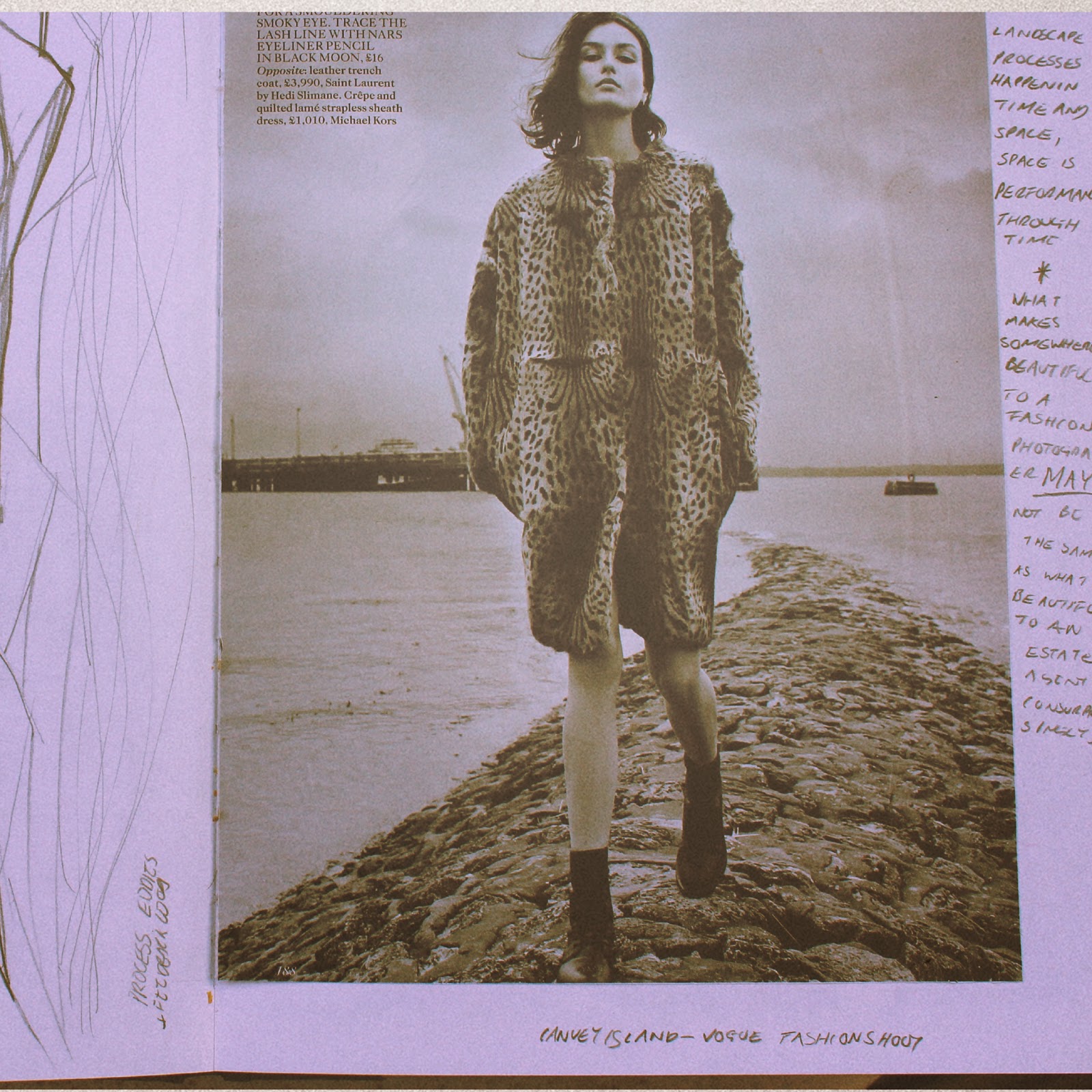
VOGUE COMES TO CANVEY


In November 2013 UK vogue decided to use Canvey Island as the location for a fashion shoot. The spread was titled Somewhere Girl- Be Carried Away by the Tides of the Season and featured a solitary model expertly shot in a variety of implausible locales around Canvey’s sea front.

The choice of location was perhaps not especially remarkable. The juxtaposition of the glamorous world of fashion against the mundanity of a fairly typical British seaside resort in fairly typical British decline serves the art director’s goal of emphasising the aspirational aspect of buying and wearing expensive clothing. It could be seen as yet another example of the fetishisation of entropy, with its antecedents in the ready-made-ruins of the picturesque garden through to the hyper documentation of central Detroit’s decline via Bernard Tschumi’s 1970s Advertisements for Architecture (“the most architectural thing about this building is the state of decay in which it is [sic]”)...though were that the intention the occidental jetty may have been a better choice of shooting location.


However, what this vapid and ephemeral fashion shoot emphasises is the way in which landscape is defined by activity. A thorough survey, a psychogeographic exploration of the temporal and historical currents running thorough the site, even GIS- do these data gathering exercises do anything other than build upon existing preconceptions in the designer’s mind? Preconceptions that can be swept away by the actions of an individual or group with their own agenda.

A landscape can be a habitat or a golf course or a playground... It can also be the location for a fashion shoot, a crime scene or a battlefield... or all of these things.  What defines space is what happens there, or in the words of Albert Camus: “Sense of space is not something that you feel, it’s something that you do.”
A landscape architect will design space with some concept of programme, perhaps defined by the brief and augmented by their own imagination. But once it is constructed, design intent is revealed to be illusory: on top of the layers imported from AutoCAD and Photoshop the user superimposes their own ideas of how the designed space is to be occupied and experienced.


So too in this post: the landscape architect’s notebook, full of oblique narrative and esoteric references, is laid bare... Only to be trampled on by someone else’s vision of what this island means.


Monday, 16 September 2013

THE VOYAGE OF победа

Lieutenant Tatiana Preobrajenskaya chewed her lower lip as she reduced the throttle on the победа as its final destination drew closer. The 32,000 tonne  Russian freighter under her control was due to dock at London Gateway in less than ten minutes, but the young woman had other designs for the победа, and her window of opportunity was closing.

Ahead of the vessel and just off the starboard bow loomed the island of Canvey. Though in plain view, Tatiana thought it pertinent to bring up a schematic of the  island’s southern coast on her display monitor. She managed a thin smile as she considered the schizophrenic imagination behind the master plan for this peculiar corner of the globe. Many years ago funding from the European Union had resulted in the creation of a daring development on the 186 hectare site. The objective had been to create 4,000 new homes along a strip of land lying largely below sea level, principally to accommodate the many workers at Tatiana's ostensible destination, Britain’s largest deepwater container port. The plan was to provide the services and infrastructure essential for the social sustainability of this new community; to furnish the thousands of new residents with spaces to exercise, to play and to consume as well as putting a roof over their heads. Grand in scope and ambition, it had been considered vital for the regeneration of the sluggish regional economy.

That desperation to resolve the economic malaise and return everything to the pre-crash status quo had led to some surprising design decisions slipping past the planning review panel. Tatiana chuckled slightly as the first zone of development came into view. Though the most conventional element within the overall plan it nevertheless demonstrated the ambition of what was to come. Addressing the constraint of the monolithic flood sea-defences by building atop the 1950s sea wall, establishing a new concourse and promenade above the original sea front which now served as a subsurface conduit for vehicular traffic. The exception to this approach had been around Ove Arup’s pavilion, which though dwarfed by the emerging residential structures was re-connected to land and sea by situating it within a sunken bowl, simultaneously referencing the prevailing marine modernism that once characterised the seafront.

The active waterfront engaged in a new dialogue with the tide, a dialogue that was joined not only by residents but also (and for the first time in many years) tourists, too.   This dialogue was extended by the extrusion of existing jetties into the water, creating a framework for new landscapes and vertical built form- a theme that would be expanded on deeper within the scheme.

Tatiana observed the density of the urban grain subside somewhat as it encroached upon Thorney Bay, the thin strip of beach so beloved by holidaymakers of the past incorporating a recreational space or perhaps a quick breath of air before once again the fabric intensified. A heterogeneous array of worker’s blocks stretched across the marshland that had once been a vast caravan park, resilient to the apocalyptic waves that were for some indeterminate future date. As with the seafront the organising structure colluded with the existing jetties and interrupted the estuary, though this time with greater gusto, and thousands of tiny vessels cleaved to their vast steel frames, some serving as homes, others as floating farms harvesting either crops or tidal energy.

Converse to the reduction in urban development’s intensity, the structures (an appropriation of existing industrial infrastructure) seemed to multiply. They extended into the waves upon great piers, the thirsty feeding tubes of a swarm of giant metallic insects.

Thoughts of the social insects flitted through Tatiana’s mind as in the distance the greatest of these structures, the Occidental Jetty, stretched along the horizon. The colonist of this new landscape matched the invertebrates in terms of industry and resourcefulness as well as scale: though vast and imposing the success of the settlement depended on the smallest of individual contributions. Nothing was wasted: the very fabric of the colony was hewn from the recycled elements of decaying hulks and abandoned containers- the waste products of the lumbering behemoth that was the gateway, further upriver. Not quite tethered to land or sea, this new city was neither grounded physically nor ideologically. It allowed the ambitions of its denizens to soar without devastating the delicate ecologies of the environment beneath them.

The Occidental colony now in sight, Tatiana drew the победа closer to the island. Beside her the alcoholic Ukrainian Captain grunted, but gave no orders. By the time he realised what the young woman was up to it would be too late.

The young lieutenant beheld the rusting cylinders that had once been liquefied methane tanks. This had once been an active industrial sector and it had taken many years to ameliorate the consequent contamination. Biotopic planting had been used to decontaminate the soil and was succeeded by a gradual phasing of human occupation to replicate the habitat at Canvey Wick, further to the west. There, sporadic forays into the brush by bored youths in stolen cars had prevented the site from reverting to its vestigial state (woodland)... in a controlled emulation of these conditions developers had encouraged the site to be exploited by live action gamers, head-up displays transforming the landscape into a virtual battle ground. The participants in these augmented reality games unwittingly facilitated the creation of the scrubby grassland so beloved by the reptiles, avians and invertebrates found at the neighbouring nature reserves.

When sufficient time had passed the denizens of the walking cities extended their tendrils backward, plugging in to the remaining framework of pumps and cylinders, exploiting the surfaces for food and fuel production. This juxtaposition of old and new, “natural” and artificial stretched to the very fringes of the project. A smattering of low density settlements (marketed as eco-homes) stood on stilts, surrounded by wet marshland and Lammas grazing. Here too the amphibious hives exerted some influence, though the relationship with their land based cousins was at times fractious. Both communities kept a watchful eye on one another.

As the good ship победа approached the great insectoid arm of the jetty it was greeted by a riot of colour, not only in the materials and fittings comprising this entity but also in the kaleidoscopic planting that covered it. The scheme was designed to recreate the terrestrial habitats in order to control pests and pollinate crops.

“What are you doing, Preobrajenskaya?” the Captain exclaimed, “why are you slowing down?”

Tatiana ignored him, surreptitiously activating a nano-alarm in her right pocket.

“What are you doing?” He repeated, “we’re suppose to be heading to Gateway! I order you to get back on course at once!”

She remained resolute. She could not turn back now. Already the Occidental colonists were gathering at the jetty-head, an eclectic array of pirates ushering the vessel towards them.

The Captain placed the barrel of a handgun against Tatiana’s temple. When he spoke his voice was calmer, but simmering with thinly veiled menace:

“Turn the ship around now or I will shoot you and do it myself.”

But she knew it was too late for the Captain to change course. Her crew mates were complicit in the mutiny: alerted by her nano-alarm, they swiftly filled the bridge, side arms all levelled on the Ukrainian Captain. His position untenable, the Captain lowered his weapon and Tatiana exhaled. Calmly, she brought the победа to dock.

Later Tatiana enjoyed a cocktail on the promenade, her gaze torn between two awesome sights. To her left she witnessed the incredible spectacle of the победа being dismantled by a vast team of men and women, stripping the ship not only of its cargo but the every panel and rivet and beam that held it together; to her right her eyes were treated to a sublime view of a chemical sunset lingering over  the distant City of London. 

She was under no illusions: this would be but a brief moment of respite before the storm that was brewing would hit the colonists. Crucially, this had been her choice. She had chosen a new way of life amongst people that respected her. Her old crew were eager to begin and were already making friends with their new hosts.

The Captain... he belonged to the past, to the cumbersome deepwater port and the crumbling city of steel and glass that it served, its phallic skyline backlit by the sinking sun. He would be executed soon enough, but nothing was wasted on the colony: his bones and blood would fortify the compost and... well, she didn’t know about the rest of him, but she’d always wanted a suede jacket.

Friday, 13 September 2013

tHE eND IS THE bEGINNING IS THE eND

NAME:                  DONOVAN, JOEY
RANK:                  ENSIGN
NUMBER:                  000517783-9
QUAL:                  BA(Hons) LANDSCAPE ARCHITECTURE
                         (UNIVERSITY OF GREENWICH, 2011)
                         CURRENTLY COMPLETING DIPLOMA
OCCUPATION:          LANDSCAPE GARDENER, WRITER, POET, MUSICIAN


“Canvey is an alluvial island in the Thames estuary surrounded by a fourteen mile wall of reinforced concrete. Nearly 48,000 people live here, and 4,000 new homes are needed. 

“This scheme revives the pioneering spirit of Canvey’s first colonist (Dutch engineer Cornelius Vermuyden) to create a dynamic new settlement on the south Essex coast. Through a process of détournement relics of the island’s industrial past are are transformed into amphibious colonies straddling land and sea: a New Jerusalem via New Babylon.”

“A New Jerusalem! How pompous!” Hindsight is indeed a marvellous thing, but it was within plain sight that the pomposity of these words were rendered unto the ensign. For whilst the rest of the cast and crew of the good ship Dreadnought were enjoying some well-deserved shore-leave, he was left stranded in the real победа, tethered to the rusting occidental jetty pondering where it had all gone wrong.

Yes, the real победа was no 32 kilo-tonne freighter but a light cargo ship that had seen far better days. Cobbled together through haphazard bricolage the vessel was barely ocean-worthy. The name of the vessel was Russian for Victory, but the first two glyphs had mysteriously disappeared, leaving only the word беда.

“Trouble,” he translated for the benefit of his imaginary audience. It was appropriate given his circumstances, for he was in a lot of trouble now thanks to the ship. Quite why he had taken on the task of breaking away from the main fleet to sail into what he described as uncharted waters was anyone’s guess... they weren’t uncharted, of course, just tricky to navigate without the appropriate skills... and a good boat.

It was all in the spirit of the site, of course. Why build a 45,000 strong town on a swamp next to an oil refinery? Because we can! Because people like Cornelius Vermuyden and Wilko Johnson are fucking pioneers, man! A day as a lion or a lifetime as a worm etcetera, etcetera... so he and his misfit crew of heteronyms embarked upon their quixotic quest and now were grounded.

The line between the победа of his fiction and the беда of reality was becoming increasingly indistinct. Wandering alone through the particle cloud of his own mind had taken a turn for the psychotic, and as he watched the sun setting over Shellhaven he wasn't sure whether he was Tatiana dreaming of the ensign or the ensign dreaming of Tatiana... he was watching the same sun set as she, sinking behind the glistening spires of the city far and away. Repetition, remember, is also a form of change.

It was beautiful, in its way, and he wondered if Blake would have felt quite the same had he seen these new satanic mills yearning for a touch of heaven. he could ask of course: it was simply a matter of tuning in to the correct frequency. Cyclothymia granted him a special affinity for waveforms of all kinds, be they the lapping tide of the Thames or electromagnetic messages drifting across the ether. It was simply a matter of getting the dosage right.

The opium fwas grown on the anterior deck of the беда, a combined hydropnic-aquaculture system grafted on to the existing desalination tanks. Load up the pipe and try not to concentrate. That was the trick: nothing was ever accomplished by actual effort, so far as he could tell: it was through trying that he now found himself in this terrible mess. To speak to Blake’s ghost he had to let his mind dwell on something else entirely, and so it was with comparative ease that he soon found himself instead fretting over the dwindling supplies of his crop. It appeared that it was rather moreish, and demand was swiftly outstripping supply: ‘the perfect product’, Burroughs had remarked in Naked Lunch. 

It was Burroughs that had led him to the Opium. The ensign had seen himself as a kind of alchemist, hoping that by pouring in sufficient quantities of radical ideas into the Canvey Project he could somehow transmute his leaden imagination into gold.

Conrad, Burroughs, Ballard, Blake... even Dickens. But there was no longer any Mr. Magwitch lurking on the marshes, and the ensign’s great expectations were to remain unfulfilled. He had to admit that he had failed.

But wait! The ley lines were aligning. Somehow his foggy intellect had sharpened the nebulous mass of his soul into an object sharp enough to puncture the veil dividing this world from the next. Just by briefly recollecting that name, Blake, he now found himself before the spirit of the godfather of psychogeography.

“Mr. Blake sir!” he intoned, “what do you make of these dark satanic mills?”

The ensign’s ethereal hand made a vague gesture to where he thought the columns of Coryton might be in relation to the disembodied Blake, but the ghost seemed disinterested, and when pressed further merely asked to be left alone with his engravings.

Ensign Donovan was crestfallen. Rejection by the ghost of Blake felt like the last straw. What now was the point? Stranded and rudderless and rapidly running out of poppies, all that he had left was the pirate radio stations that he listened to through the mercury in his mouth. Of course, the pirate stations (many based upon the North sea forts not far from Canvey that had inspired Constant’s New Babylon) had long since disbanded, though remnants of their signals still reverberated through the wrought iron supports that held the jetty up.

Yes, everything was clear now: in sharp relief he saw a project that had failed because it had not followed through on its vision. In its attempts to describe a future possible world (if not necessarily a better one) it had not delivered an image that was strong enough, iconic enough or... well, it simply wasn’t as polemical as it thought it was, was it? The ensign frowned. He’d heard those words before: was that a thought of his own or another radio message from the past? He laughed: of course it was the latter, there were no thoughts of his own, there were only radio signals from the past.

But hark: the radio in his brain was crackling to life!

“ENSIGN DONOVAN!” It was Colonel Kurtz... no, wait... Commodore Kotzen? “You have to finish what you have started. Report back to us by the end of August and we may reconsider your commission!”

The Ensign punched the air gleefully. the tide had totally gone out and he was stranded in a rusty boat with a dwindling poppy supply, but everything was going to be okay.

It was going to be okay... right?

Friday, 31 May 2013

DESIGN DEVELOPMENT AREA III

These past few months I have been desperately attempting to complete my landscape architecture diploma, hence the lack of blog activity. The end in sight, I thought it pertinent to share some of the work I will be presenting to the external examiners next week.

The following images were all produced for the third design development area, the occidental colony.


The purpose of the third development area was to produce a cogent planting scheme whilst remaining true to the underlying concepts espoused in the original master plan. Native species were utilised in accordance with the ecological imperative of the master plan, with the plant list drawn from the Natural History Museum's postcode analysis:

As with the other development areas, I produced AUTOCAD models prior to refining the design, the better to understand the spatial relationships engendered by the layout.  With the addition of materials, these rendered reasonably well within Autocad and represent interesting concept models:


With the assessment criteria for this development area focussing principally on technical execution and plant knowledge, it was right that the majority of drawings produced were planting schemes. As I was producing vector drawings in plan, I elected to invert the colours to white on black to make them stand out more. This scheme was replicated in the title sheet (top). 
Unifying the third development area drawings with a white-on-black colour scheme inspired me to carry a similar theme with the other two development areas. In contrast to the black gloss used for this area I used a buff/grey and mauve/blue sugar paper for the hardworks and wetland areas respectively. The rough texture also permitted the use of chalk and charcoal to augment the vector drawings. I will post here Monday or Tuesday.


Friday, 8 March 2013

SKETCHBOOK PAGES

Adaptations for colonisation of water:


Fauna of Canvey Wick:


Lepidoptera:


Canvey Psychogeography:


Tuesday, 5 March 2013

BBC - CANVEY FLOOD 1953

A very short BBC film about the Canvey and the flood of 1953... my favourite line: "Canvey's safe...but for how long?You've got to be vigilant.. with global warming you've always got to be vigilant."


Sunday, 3 March 2013

Refining the Masterplan

Some sketch developments of the conceptual master plan for canvey, examining networks and organising structures in plan view.


 Canvey Wick- wetland/ salt-marsh with built structure extending into the Estuary


...Thorney Bay as high-density development 


...Sea Front

Monday, 25 February 2013

Masterplanning Canvey

We begin with the site and its context: 7.2 square miles of alluvial island on the South Essex coast:


Most of the island sits below sea level:


Some quick zoning. for some reason this image is horizontally flipped:


The beginnings of a context board with satellite image...


Sketch ideas for landscape features...


The workspace...


A work in progress...


Layer one...

Layer two...


The two drawings combined in Photoshop...


Just a sketch design, lots of work to do... the main issue being that my chosen site is over 100ha in size. The idea is to create 4,000 new homes in South Canvey that are sensitive to the unique environmental and cultural issues facing the island.

Much more to follow. Stay tuned.

Sunday, 3 February 2013

Canvey: Oil City


Oil Refining at Coryton glimpsed from across the  West Canvey Marsh
Yesterday residents of coastal towns throughout the United Kingdom, Belgium and the Netherlands commemorated the sixtieth anniversary of North Sea Flood of 1953. Of the 307 people killed on land in the United Kingdom 58 died during flooding at Canvey Island in the Thames Estuary. Canvey Island is the site of my final student project for the University of Greenwich.

This alluvial island- separated from the mainland by a network of narrow, tidal creeks- has been occupied since pre-Roman times and has an average elevation approximately three metres below mean high water level.. 


The marina  at low tide

Presently it is home to some 34,000 people, with 14 miles of sea defences and a weekly flood alarm protecting them from the rising tide.  A concrete wall surrounds the entire island: though it is only separated from the South Essex mainland by less than 100 metres, this structure (and the fact that it only two roads connect the land mass to the South Essex coat) reinforce the sense of separateness and isolation.

...the sea defence: a 3 metre high wall surrounding the island's perimeter

Share buttons